






Travelling with a cochlear implant is easy once you know what to pack and what to expect at the airport. The main risks are simple ones: a forgotten charger, a battery that runs flat on a long flight, or a cable that breaks far from home. This guide gives you a packing list, airport tips and a few habits that keep your sound working for the whole trip.
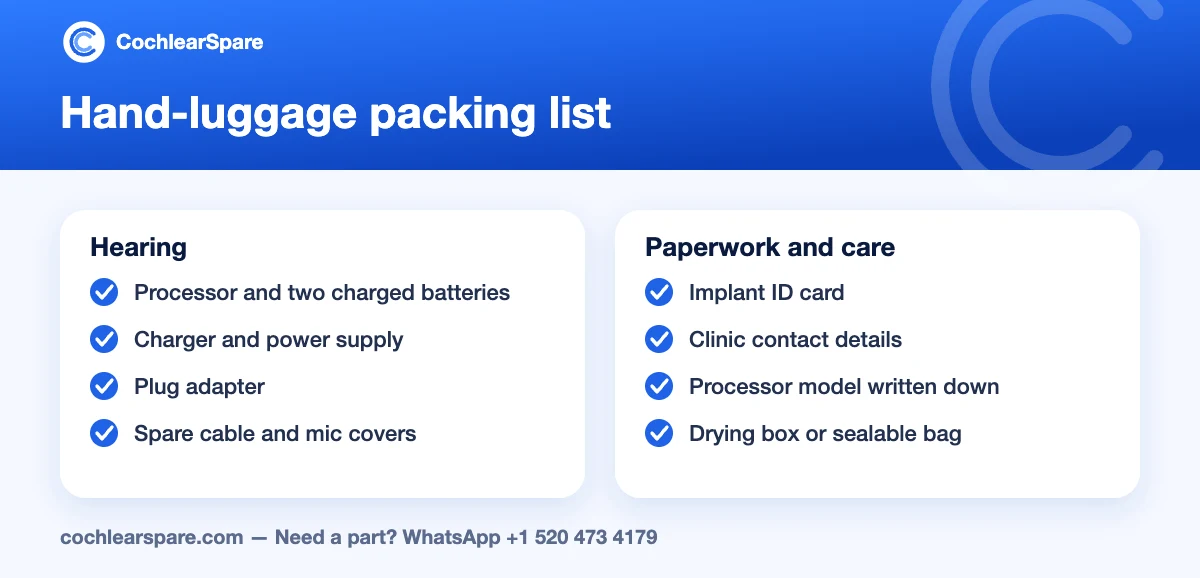
Packing list: what goes in your hand luggage
Keep everything you need for hearing in your hand luggage, not in a checked bag. Checked bags can be delayed or lost, and spare lithium batteries are generally not allowed in checked luggage.
- Your processor and at least two charged batteries
- The charger and its power supply or USB cable
- A plug adapter for the country you are visiting
- A spare cable and spare microphone covers
- A drying box or a sealable bag with a drying sachet
- Your implant ID card and your clinic’s contact details
- Your processor model written down, in case you need a part abroad
At airport security
- Carry your implant ID card and show it if you are asked about your device.
- Tell security staff that you wear a cochlear implant before you go through.
- Follow the advice in your processor’s user guide about walk-through detectors and body scanners. If you are unsure, ask for an alternative screening.
- Keep spare batteries in a case so the contacts cannot touch coins or keys.
- If you take the processor off for screening, keep it in sight and put it straight back on afterwards.
On the plane
Long flights can be tiring for anyone, and background noise is high. A few tips help:
- Board with a fully charged battery, and keep the spare within reach rather than in the overhead bin.
- Tell the cabin crew that you wear a cochlear implant if you may not hear announcements clearly.
- Many people keep the processor on during the flight. If you take it off to sleep, put it in a case, not loose in a seat pocket.
Charging abroad
Most processor chargers run from a standard mains power supply or USB, so a simple plug adapter is usually all you need. Check the voltage range printed on your charger’s power supply before you leave. Charge every night, even if the battery still has some power, so you start each day full. In hotels, keep the charger away from the bathroom and from sunny windows.
Heat, humidity, sand and water
- Heat: never leave the processor or batteries in a hot car, on a sunbed or in direct sun.
- Humidity: use a drying box every night in humid places to protect the processor and microphones.
- Sand: wipe the processor and change microphone covers after a beach day.
- Water: take the processor off before swimming unless you use a water accessory made for your model, and dry everything well afterwards.
If a part breaks while you are away
- Swap in your spare cable or battery first. This fixes most problems.
- Check the coil is on the head and the microphone covers are clean.
- Contact your clinic if the processor itself seems faulty.
- If you need a replacement part, send us your model and delivery address on WhatsApp. We ship to most countries with tracking, and most orders leave within 24–48 hours.
Travelling with a cochlear implant: final checklist
- Processor, two charged batteries, charger and plug adapter in hand luggage
- Spare cable and microphone covers
- Drying box or sealable bag
- Implant ID card and clinic contacts
- Processor model written down
Need spares before you go? We stock batteries, chargers and cables for Cochlear Nucleus, Advanced Bionics Naída CI and MED-EL processors.
Not sure which part fits? Send a photo of your processor on WhatsApp (+1 520 473 4179) and we will confirm the right part before you pay.
FAQ
Can I take spare processor batteries on a plane?
Yes, in your hand luggage. Spare lithium batteries are generally not allowed in checked luggage. Check your airline’s rules before you fly.
Do I need to take my processor off at security?
Follow the guidance in your processor’s user guide and tell security staff about your implant. Carry your implant ID card.
Will my charger work in another country?
Usually yes with a plug adapter, as long as the voltage range on the power supply covers the local mains voltage.
What should I do if my cable breaks abroad?
Use your spare cable. If you need a new one, message us your model and address and we will ship it with tracking.
Sound Processor Care: A Simple Daily and Weekly Routine
Cochlear Implant Spare Kit for Children: What to Keep at Home, School and on the Go

Back to School with a Cochlear Implant: A Checklist for Parents

Cochlear Nucleus 7 Spare Parts Guide (CP1000): Care, Fixes and Where to Buy
Cochlear Nucleus 6 Spare Parts Guide (CP910 & CP920): Care, Fixes and Where to Buy

Cochlear Nucleus 5 Spare Parts Guide (CP810 & CP802): Care, Fixes and Where to Buy

Naída CI Replacement Parts Guide: Q90, Q70, Q30 & Marvel

Cochlear Implant Cable Replacement: 7 Signs Your Cable Needs Replacing
How Long Do Cochlear Implant Batteries Last? Replacement Guide

AB Harmony Replacement Parts Guide: Batteries, Headpieces & Accessories